> For the complete documentation index, see [llms.txt](https://docs.overleaf.com/llms.txt). Markdown versions of documentation pages are available by appending `.md` to page URLs; this page is available as [Markdown](https://docs.overleaf.com/managing-projects-and-files/downloading-a-project.md).
# Downloading a project
This page explains how to export Overleaf projects as a .zip file or download just the final typeset PDF. Each process is explained step-by-step but a quick guide is also provided.
{% hint style="info" %}
Projects downloaded from Overleaf are provided as a `.zip` file. The `.zip` file will contain the source files *only.* It *does not* include the final typeset PDF, which must be [downloaded separately](#how-to-download-the-pdf-file) after successful compilation.
{% endhint %}
## How to download the PDF file
There are two ways to download the PDF file:
* [#from-the-file-menu](#from-the-file-menu "mention")
* [#from-the-download-icon](#from-the-download-icon "mention")
### From the File menu
{% stepper %}
{% step %}
Select **File** in the upper-left of the editor window.
{% endstep %}
{% step %}
Select **Download as PDF** within the **Download** option of the dropdown menu:
{% endstep %}
{% step %}
The typeset PDF is then exported in accordance with your browser and operating system settings, usually to your device's downloads folder. By default, the downloaded PDF will have the same name as your Overleaf project.
{% endstep %}
{% endstepper %}
### From the download icon
{% stepper %}
{% step %}
From within the PDF display window, select the **Download PDF** icon to the right of the **Recompile** button:
{% endstep %}
{% step %}
The typeset PDF is then exported in accordance with your browser and operating system settings, usually to your device's downloads folder. By default, the downloaded PDF will have the same name as your Overleaf project.
{% endstep %}
{% endstepper %}
## How to download Overleaf projects
Here we show how to download your current project as a `.zip` file, or how to download multiple projects as a single `.zip` file inside of which there are further `.zip` files, one for each project.
### How to download an individual project as a `.zip` file
There are two ways to download an individual project as a `.zip` file:
* [#from-within-the-project](#from-within-the-project "mention")
* [#from-the-projects-dashboard](#from-the-projects-dashboard "mention")
#### From within the project
{% stepper %}
{% step %}
Select **File** in the upper-left of the editor window.
{% endstep %}
{% step %}
Select **Download as source (.zip)** within the **Download** option of the dropdown menu:
{% endstep %}
{% step %}
The project source code will be exported as a `.zip` file in accordance with your browser and operating system settings, usually to your device's downloads folder. By default, the `.zip` file will have the same name as your Overleaf project.
{% endstep %}
{% endstepper %}
#### From the projects dashboard
{% stepper %}
{% step %}
If you're in the editor, select the **Back to your projects** button in the top-left, which appears with your cursor on :
{% endstep %}
{% step %}
In the projects dashboard, click the **Download .zip file** button for the project you want to download:
{% endstep %}
{% step %}
The project source code will be exported as a `.zip` file in accordance with your browser and operating system settings, usually to your device's downloads folder. By default, the `.zip` file will have the same name as your Overleaf project.
{% endstep %}
{% endstepper %}
### How to download multiple projects as a `.zip` file
{% stepper %}
{% step %}
If you're in the editor, select the **Back to your projects** button in the top-left, which appears with your cursor on :
{% endstep %}
{% step %}
In the projects dashboard, select the projects using the checkboxes.
{% endstep %}
{% step %}
Click the **Download** icon on the top-right to initiate download of the `.zip` file containing your projects.
{% endstep %}
{% step %}
The project source codes will be exported as a `.zip` file in accordance with your browser and operating system settings, usually to your device's downloads folder. The `.zip` file will be named "Overleaf Projects (*\[number of projects]* items)".
{% endstep %}
{% endstepper %}
## How to include a `.bbl` file (for journal submissions)
Some journal-submission processes ask for the LaTeX-generated `.bbl` file—an auxiliary file containing the formatted bibliography data—to be included with the article source files of LaTeX submissions. On Overleaf, `.bbl` files, and any other auxiliary files created during compilation, are “cached” but there are two ways to access the `.bbl` files:
* [#using-the-other-logs-and-files-button](#using-the-other-logs-and-files-button "mention")
* [#via-overleafs-arxiv-submission-process](#via-overleafs-arxiv-submission-process "mention")
### Using the **Other logs and files** button
Follow these steps to download just the `.bbl` file generated for your project:
{% stepper %}
{% step %}
Click on the **Logs and output files** button (next to the **Recompile** button).
{% endstep %}
{% step %}
Scroll all the way down, and click on **Other logs and output files**.
{% endstep %}
{% step %}
Select the project’s `.bbl` file, called `output.bbl`, to download it.
{% endstep %}
{% endstepper %}
### Via Overleaf’s arXiv submission process
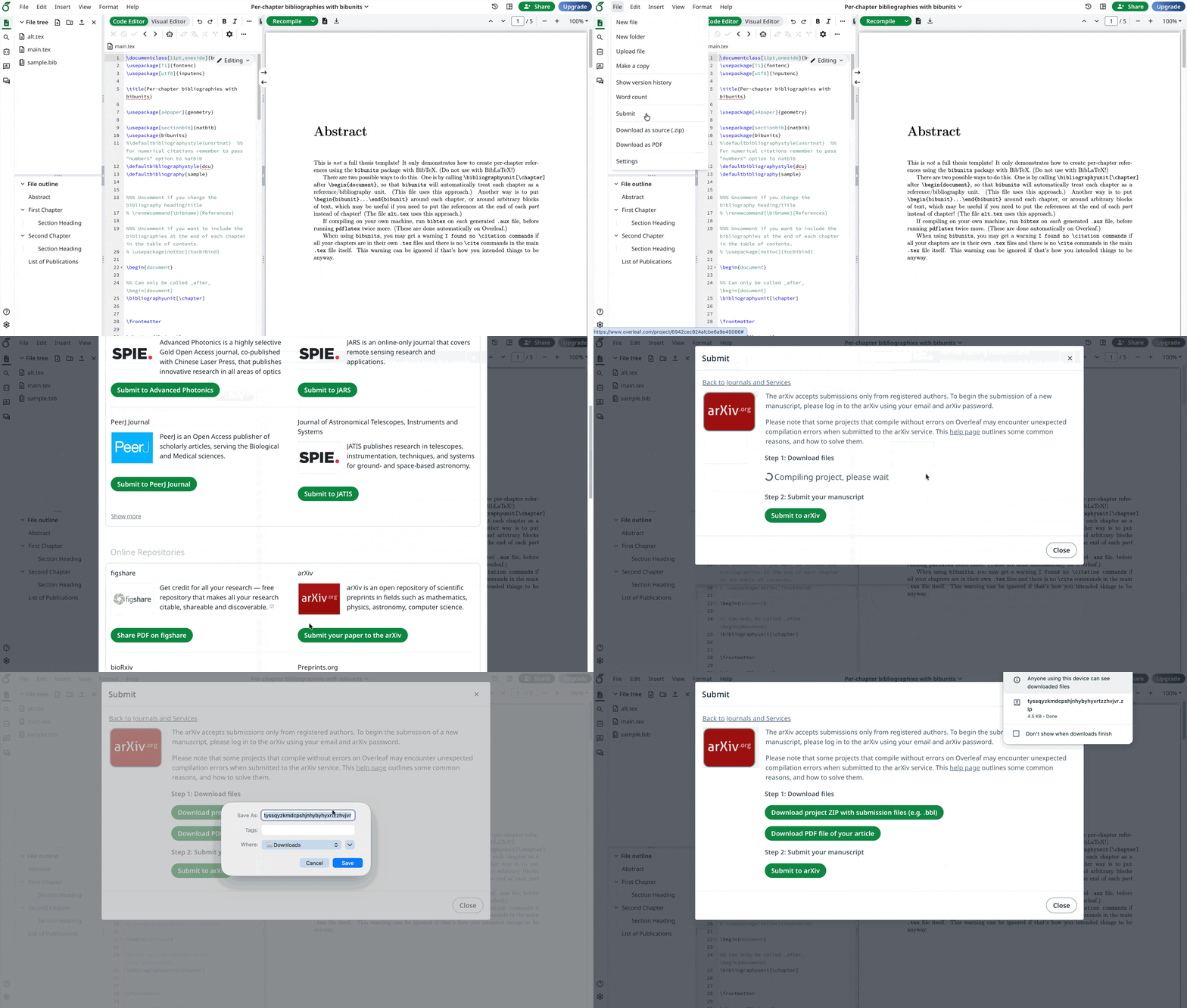
The full project source files, including the `.bbl` file, can also be downloaded via the arXiv-submission process:
{% stepper %}
{% step %}
Click on the project title and click on **Submit**.
{% endstep %}
{% step %}
Overleaf displays the **Submit** window which lists Overleaf’s publishing partners. Scroll down until you reach the **Online Repositories** section which contains arXiv.
{% endstep %}
{% step %}
From within the arXiv section, select **Submit your paper to the arXiv**.
{% hint style="info" %}
Don't worry, selecting this option this will *not* immediately send the project files to arXiv; instead, it displays another window which lets you download your article, complete with `.bbl` file, for onward submission to arXiv:
{% endhint %}
{% endstep %}
{% step %}
Finally, select **Download project ZIP with submission files (e.g. .bbl)** which will initiate the download process.
{% endstep %}
{% endstepper %}
---
# Agent Instructions
This documentation is published with GitBook. GitBook is the documentation platform designed so that both humans and AI agents can read, navigate, and reason over technical content effectively. Learn more at gitbook.com.
## Querying This Documentation
If you need additional information that is not directly available in this page, you can query the documentation dynamically by asking a question.
Perform an HTTP GET request on the current page URL with the `ask` query parameter, and the optional `goal` query parameter:
```
GET https://docs.overleaf.com/managing-projects-and-files/downloading-a-project.md?ask=&goal=
```
`ask` is the immediate question: it should be specific, self-contained, and written in natural language.
`goal` is optional and describes the broader end goal you are ultimately trying to accomplish on behalf of the user. GitBook uses it to tailor the answer towards what is most useful for that goal.
The response will contain a direct answer to the question and relevant excerpts and sources from the documentation.
Use this mechanism when the answer is not explicitly present in the current page, you need clarification or additional context, or you want to retrieve related documentation sections.